
One platform that runs a community from raw land all the way to delivered lots - then keeps right on going, carrying those same lots through builder takedowns, home sales, and closings without ever leaving Pipsy.
Every other tool tracks the execution of a land deal. Pipsy is the system you actually underwrite and finance the deal in - and the only one where the finished product, platted sections and lots, flows directly into the same platform's home-sales, ARC, and contract modules. One parcel, one timeline, no re-keying between systems.
From sourcing to closed homes, every platted section runs on one continuous timeline - and it loops back: gap-out analysis on the vertical side tells the team when to start the next phase before lots run dry.
Underwrite
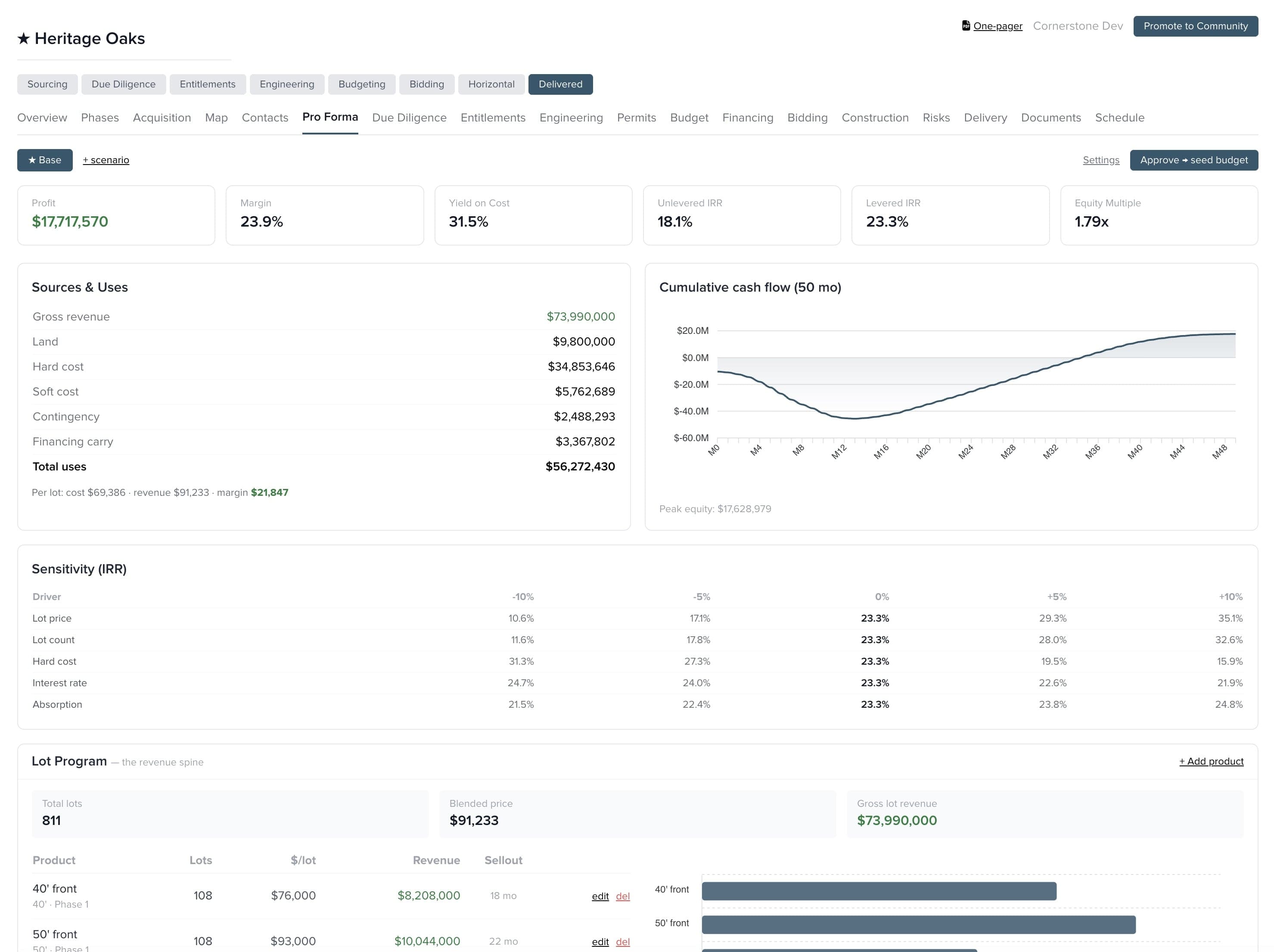
Know what the dirt is worth before you chase it. Model the deal, the capital stack, and the returns - then approve a pro forma that seeds the project budget automatically.
Contracts, takedowns, carry, and reconciliation run in LotTrust
Deal Sourcing & Pipeline
A visual deal pipeline - Kanban by status - for every parcel you're chasing: APN, acreage, asking price, close probability, and target close date, backed by a broker and seller rolodex. Quick-underwrite any parcel before you commit.
Underwriting & Pro Forma
Build base, upside, and downside scenarios on an editable spreadsheet-style grid and compute Residual Land Value - what you can actually pay for the dirt - for an instant go/no-go against the ask. Get profit, margin, yield-on-cost, unlevered and levered IRR, and equity multiple off a month-by-month cash flow, plus a sensitivity grid and Monte Carlo across lot price, count, cost, rate, and absorption. Give each phase its own lot cost per front foot and the engine prices that phase as a hard cost across its own window, then reports cost per lot and margin per lot for every product you are selling. Start from your own template library, and approving a pro forma snapshots it and seeds the project budget automatically.
Builder Commitments & The Living Model
Track every builder relationship down its real path - LOI, PSA, option or land bank, executed contract - with the takedown cadence and incentives you agreed to. The model then stays alive: underwritten lot products on one side, contracted commitments in the middle, and actual funded closings and selling velocity on the other, so you can see takedown risk building long before a builder misses. Each lot product carries its own tax card - ISD, county, MUD, PID, and HOA rates in one place.
Capital Stack & Financing
Model the whole capital stack: acquisition and development loans, equity, mezzanine, seller notes, and lines of credit, with running balances, interest carry, and loan-to-cost / loan-to-value covenants that feed straight back into the levered pro forma.
Draw Requests & Funding
Route every draw through submit, review, approve, and fund, with availability and covenant re-checks at each step. Approve or fund less than was requested with per-line reconciliation, edit a request in place (a rejected one reopens to review), and back-dated advances re-sequence the ledger automatically. Every request carries a discussion thread with @mentions.
Joint Ventures
Model equity partners as capital-stack slices - ownership share, preferred return, and sponsor promote - then run a distribution waterfall (return of capital, then preferred, then a profit split with promote carved out) with per-partner IRR and equity multiple, computed from recorded events.
Capital Partners
Give lenders and JV investors a read-only portal scoped to the facilities they fund: commitments, outstanding, availability, and draw requests to acknowledge. Their acknowledgements post to the request's thread, your internal notes stay private, and they never see the pro forma, budget lines, or your margin.
Acquisition Structures
Option, rolling takedown, land-bank, and outright purchase structures - with an earnest-money deposit ladder (at-risk vs. refundable, go-hard dates) so you always know what's on the line. Land-bank and option facilities carry straight through to LotTrust, where the carry, takedowns, and reconciliation run.
Public Finance & District Operations
Track MUD, PID, TIF, and impact-fee-credit reimbursements - eligible cost, bond issuance, amounts received - and net land basis after reimbursements, all feeding the pro forma. Each district gets a full operating view: an ESFC register computed from real lot closings against the bond threshold, a developer-interest clock against its cap, the engineer's 95% and final completion certificates per construction contract, and bond-application readiness that names its blockers in plain words. Export the whole bond packet as a PDF and CSV.
Capital Portfolio & Program Views
A Capital Portfolio rolls every deal and dollar into one view - development projects, land-bank facilities, debt, and JV equity - with capital committed, deployed, and at risk, a third-party vs intercompany split, and a ranked attention list. Add a program dashboard for stage distribution, schedule health, and a risk heat grid, with alerts for expiring deadlines, covenant breaches, and budget overruns.
A visual deal pipeline - Kanban by status - for every parcel you're chasing: APN, acreage, asking price, close probability, and target close date, backed by a broker and seller rolodex. Quick-underwrite any parcel before you commit.
Build base, upside, and downside scenarios on an editable spreadsheet-style grid and compute Residual Land Value - what you can actually pay for the dirt - for an instant go/no-go against the ask. Get profit, margin, yield-on-cost, unlevered and levered IRR, and equity multiple off a month-by-month cash flow, plus a sensitivity grid and Monte Carlo across lot price, count, cost, rate, and absorption. Give each phase its own lot cost per front foot and the engine prices that phase as a hard cost across its own window, then reports cost per lot and margin per lot for every product you are selling. Start from your own template library, and approving a pro forma snapshots it and seeds the project budget automatically.
Track every builder relationship down its real path - LOI, PSA, option or land bank, executed contract - with the takedown cadence and incentives you agreed to. The model then stays alive: underwritten lot products on one side, contracted commitments in the middle, and actual funded closings and selling velocity on the other, so you can see takedown risk building long before a builder misses. Each lot product carries its own tax card - ISD, county, MUD, PID, and HOA rates in one place.
Model the whole capital stack: acquisition and development loans, equity, mezzanine, seller notes, and lines of credit, with running balances, interest carry, and loan-to-cost / loan-to-value covenants that feed straight back into the levered pro forma.
Route every draw through submit, review, approve, and fund, with availability and covenant re-checks at each step. Approve or fund less than was requested with per-line reconciliation, edit a request in place (a rejected one reopens to review), and back-dated advances re-sequence the ledger automatically. Every request carries a discussion thread with @mentions.
Model equity partners as capital-stack slices - ownership share, preferred return, and sponsor promote - then run a distribution waterfall (return of capital, then preferred, then a profit split with promote carved out) with per-partner IRR and equity multiple, computed from recorded events.
Give lenders and JV investors a read-only portal scoped to the facilities they fund: commitments, outstanding, availability, and draw requests to acknowledge. Their acknowledgements post to the request's thread, your internal notes stay private, and they never see the pro forma, budget lines, or your margin.
Option, rolling takedown, land-bank, and outright purchase structures - with an earnest-money deposit ladder (at-risk vs. refundable, go-hard dates) so you always know what's on the line. Land-bank and option facilities carry straight through to LotTrust, where the carry, takedowns, and reconciliation run.
Track MUD, PID, TIF, and impact-fee-credit reimbursements - eligible cost, bond issuance, amounts received - and net land basis after reimbursements, all feeding the pro forma. Each district gets a full operating view: an ESFC register computed from real lot closings against the bond threshold, a developer-interest clock against its cap, the engineer's 95% and final completion certificates per construction contract, and bond-application readiness that names its blockers in plain words. Export the whole bond packet as a PDF and CSV.
A Capital Portfolio rolls every deal and dollar into one view - development projects, land-bank facilities, debt, and JV equity - with capital committed, deployed, and at risk, a third-party vs intercompany split, and a ranked attention list. Add a program dashboard for stage distribution, schedule health, and a risk heat grid, with alerts for expiring deadlines, covenant breaches, and budget overruns.
Build
Run entitlements, engineering, and horizontal construction with real cost control - bids leveled, change orders tracked, bonds and draws managed, every milestone on the critical path.
Due Diligence
Stage-appropriate checklists - Phase I ESA, geotech, title, survey - with critical-item gating that blocks a stage from advancing until blockers clear, and a DD-deadline countdown that warns before the period expires.
Go-Hard Decisions & The DD Packet
Due diligence stops being a folder of PDFs and becomes a decision. Findings are typed and judged by their own rules - utility capacity and will-serve letters, mineral and surface rights, floodplain and LOMR status, title and survey exceptions, environmental, geotech, zoning, and district - each capturing the numbers that actually decide a deal, like fire flow available against fire flow required, or LUEs available against LUEs required. A feasibility clock and soft-cost burn run against your option period, lot-yield versions track each land-plan revision and can be pushed back into underwriting, and the whole thing prints as a go-hard packet so you commit, walk, or extend on the record.
Entitlements
Track every approval - preliminary and final plat, zoning, development agreement - with conditions of approval, hearing dates, and expiration tracking with extension logging. Start from a Texas master-planned template instead of a blank page, and let the development agreement become a live obligation register that seeds its own budget lines as each stage advances. Construction-season risk is called out on the path, blockers stop a stage from advancing before it should, and nightly scanners watch every clock, because a lapsed tentative map can kill a deal.
Engineering & Civil Plans
Manage civil plan sets through review rounds and approval stamps.
Permits & Fees
A permit register with jurisdiction, numbers, status, fees, and expiration scanning.
Budget & Cost Control
Development budgets with full cost control - Original → Approved Change Orders → Revised → Committed → Actual → Variance by category, plus ETC, EAC, and variance-at-completion - and a change-order log whose approval workflow rolls cost and schedule impact into the revised budget. Underneath runs one connected ledger: an award becomes a scope, a scope carries a schedule of values, pay-application lines sit on those SOV lines, and draws are drawn from them. Every line is classified as district-eligible, developer share, or non-district, so your reimbursable cost is computed from the ledger itself rather than rebuilt in a spreadsheet at bond time.
Bidding & Bid Leveling
Issue bid packages, collect vendor bids, and level them on an apples-to-apples grid that flags scope gaps and shows the adjusted-low before you award - straight into the committed budget. Leveling is the award path, not a side exercise: each column shows its unpriced cells, undecided exclusions, and open clarifications, exclusions lift out of the bid text into a grid you plug, accept, reject, or waive, and the plan the bids were priced against is locked so you are told when a bid has gone stale. Award stays disabled until the reasons clear, and awarding anyway records who overrode it and why.
Construction Management
Construction scopes with contract values, AIA-style (G702/G703) pay applications that move through their own submit, review, and approve gate with retainage, lien waivers, performance and subdivision bonds (post to release with exposure tracking), punch lists, and daily field logs with weather, crews, activities, and photos. Hand your lender a complete draw package as a PDF and CSV without assembling it by hand.
Schedule - Gantt & Critical Path
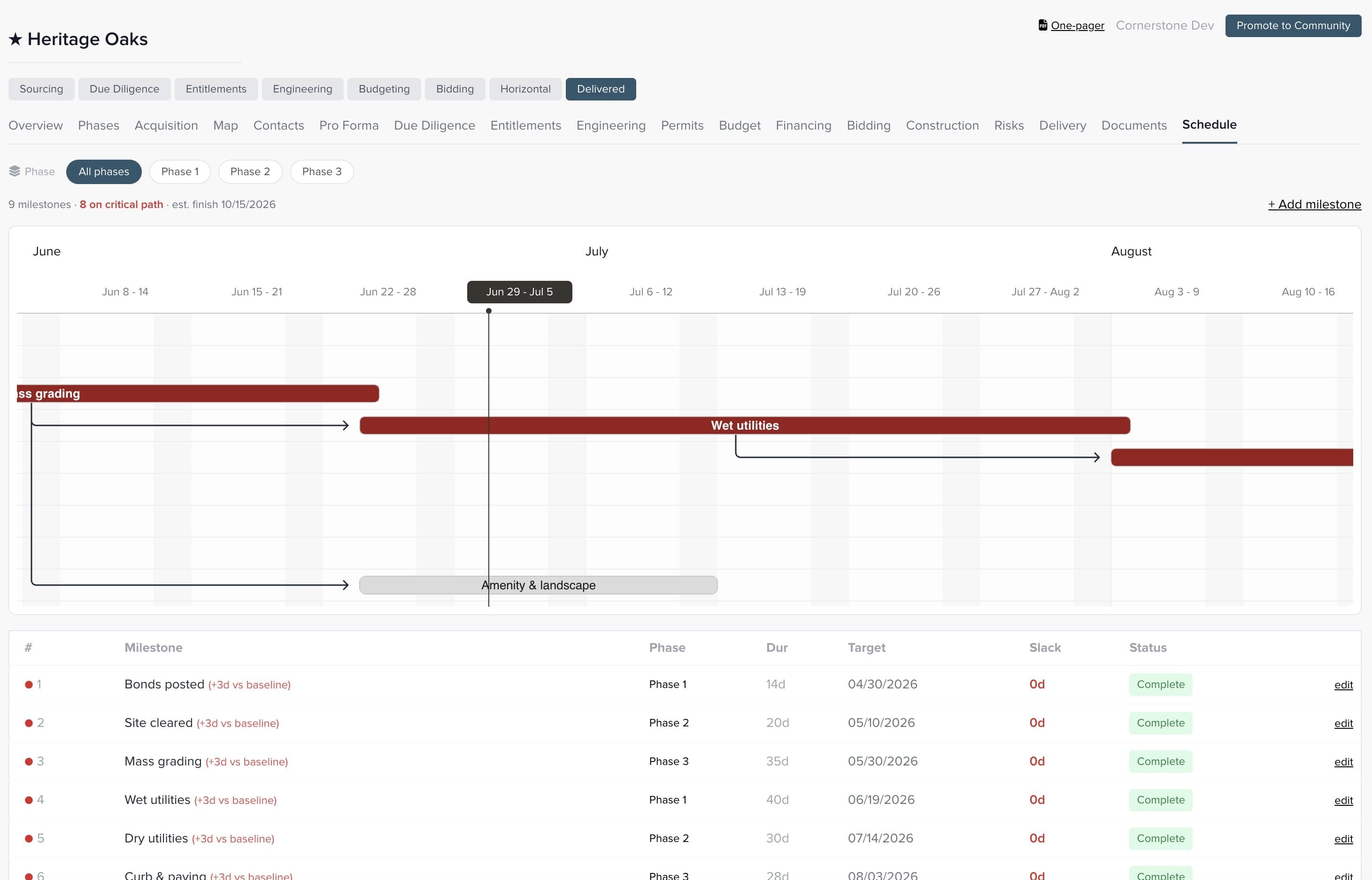
A milestone schedule with dependencies, baseline-vs-actual, critical-path highlighting, and percent-complete. Every milestone carries a note for the things a date cannot say - who is waiting on whom, the risk, the decision that was made - and it reads straight off the bar on the chart.
The Schedule Board
Every project's schedule on one board. The same critical-path engine that runs a single project runs across all of them, and the results stack into one chart grouped by project, with each project's phases and milestones underneath. Filter by community, stage, category, or status, narrow to only the critical path or only what is late, and pull the horizon in to the next 90 days or out to the full year - the tiles follow the filter, counting what is on the critical path, overdue, due soon, slipped against baseline, and which projects have a gate that misses the dirt season. Export the whole board to a workbook. It is deliberately read-only, because a drag here would move a date for everyone; rescheduling stays one click away on the project's own tab.
Phasing
Subdivide a parcel into phases - each with its own lot count, acreage, budget, bonds, milestones, status, and boundary - mapping 1:1 to a downstream platted section.
Plat Intake
Drop in the engineer's DWG or LandXML and let Pipsy convert it: assign blocks or lot-number ranges to the phase they belong to, and the geometry, parcel boundary, and lot counts come with them. Get it wrong and you revert it. When the phase promotes, those become real lots carrying their real shapes, so the map your team works from is the plat, not a redrawn approximation.
Field Log
A phone-first field tool for the person standing on the lot. Punch items are scoped to the lot in front of you with camera photos and GPS stamped on, status changes happen in the field instead of back at a desk, and the daily log records the phase, the lots actually worked, manpower, and equipment. Those same punch items are what a lot's readiness certificate checks before it will call the lot clear.
Risk Register
A likelihood × impact risk board with mitigation, owner, and dollars-at-risk, rolled up to the program dashboard.
Vendor & Builder Portal
Scoped logins for recurring builders and consultants, account-free magic-link access for one-off vendors to view a package and submit a bid, and a locked-down, horizontal-only Development Vendor login that exposes none of the sales side.
Stage-appropriate checklists - Phase I ESA, geotech, title, survey - with critical-item gating that blocks a stage from advancing until blockers clear, and a DD-deadline countdown that warns before the period expires.
Due diligence stops being a folder of PDFs and becomes a decision. Findings are typed and judged by their own rules - utility capacity and will-serve letters, mineral and surface rights, floodplain and LOMR status, title and survey exceptions, environmental, geotech, zoning, and district - each capturing the numbers that actually decide a deal, like fire flow available against fire flow required, or LUEs available against LUEs required. A feasibility clock and soft-cost burn run against your option period, lot-yield versions track each land-plan revision and can be pushed back into underwriting, and the whole thing prints as a go-hard packet so you commit, walk, or extend on the record.
Track every approval - preliminary and final plat, zoning, development agreement - with conditions of approval, hearing dates, and expiration tracking with extension logging. Start from a Texas master-planned template instead of a blank page, and let the development agreement become a live obligation register that seeds its own budget lines as each stage advances. Construction-season risk is called out on the path, blockers stop a stage from advancing before it should, and nightly scanners watch every clock, because a lapsed tentative map can kill a deal.
Manage civil plan sets through review rounds and approval stamps.
A permit register with jurisdiction, numbers, status, fees, and expiration scanning.
Development budgets with full cost control - Original → Approved Change Orders → Revised → Committed → Actual → Variance by category, plus ETC, EAC, and variance-at-completion - and a change-order log whose approval workflow rolls cost and schedule impact into the revised budget. Underneath runs one connected ledger: an award becomes a scope, a scope carries a schedule of values, pay-application lines sit on those SOV lines, and draws are drawn from them. Every line is classified as district-eligible, developer share, or non-district, so your reimbursable cost is computed from the ledger itself rather than rebuilt in a spreadsheet at bond time.
Issue bid packages, collect vendor bids, and level them on an apples-to-apples grid that flags scope gaps and shows the adjusted-low before you award - straight into the committed budget. Leveling is the award path, not a side exercise: each column shows its unpriced cells, undecided exclusions, and open clarifications, exclusions lift out of the bid text into a grid you plug, accept, reject, or waive, and the plan the bids were priced against is locked so you are told when a bid has gone stale. Award stays disabled until the reasons clear, and awarding anyway records who overrode it and why.
Construction scopes with contract values, AIA-style (G702/G703) pay applications that move through their own submit, review, and approve gate with retainage, lien waivers, performance and subdivision bonds (post to release with exposure tracking), punch lists, and daily field logs with weather, crews, activities, and photos. Hand your lender a complete draw package as a PDF and CSV without assembling it by hand.
A milestone schedule with dependencies, baseline-vs-actual, critical-path highlighting, and percent-complete. Every milestone carries a note for the things a date cannot say - who is waiting on whom, the risk, the decision that was made - and it reads straight off the bar on the chart.
Every project's schedule on one board. The same critical-path engine that runs a single project runs across all of them, and the results stack into one chart grouped by project, with each project's phases and milestones underneath. Filter by community, stage, category, or status, narrow to only the critical path or only what is late, and pull the horizon in to the next 90 days or out to the full year - the tiles follow the filter, counting what is on the critical path, overdue, due soon, slipped against baseline, and which projects have a gate that misses the dirt season. Export the whole board to a workbook. It is deliberately read-only, because a drag here would move a date for everyone; rescheduling stays one click away on the project's own tab.
Subdivide a parcel into phases - each with its own lot count, acreage, budget, bonds, milestones, status, and boundary - mapping 1:1 to a downstream platted section.
Drop in the engineer's DWG or LandXML and let Pipsy convert it: assign blocks or lot-number ranges to the phase they belong to, and the geometry, parcel boundary, and lot counts come with them. Get it wrong and you revert it. When the phase promotes, those become real lots carrying their real shapes, so the map your team works from is the plat, not a redrawn approximation.
A phone-first field tool for the person standing on the lot. Punch items are scoped to the lot in front of you with camera photos and GPS stamped on, status changes happen in the field instead of back at a desk, and the daily log records the phase, the lots actually worked, manpower, and equipment. Those same punch items are what a lot's readiness certificate checks before it will call the lot clear.
A likelihood × impact risk board with mitigation, owner, and dollars-at-risk, rolled up to the program dashboard.
Scoped logins for recurring builders and consultants, account-free magic-link access for one-off vendors to view a package and submit a bid, and a locked-down, horizontal-only Development Vendor login that exposes none of the sales side.
See the Whole Community
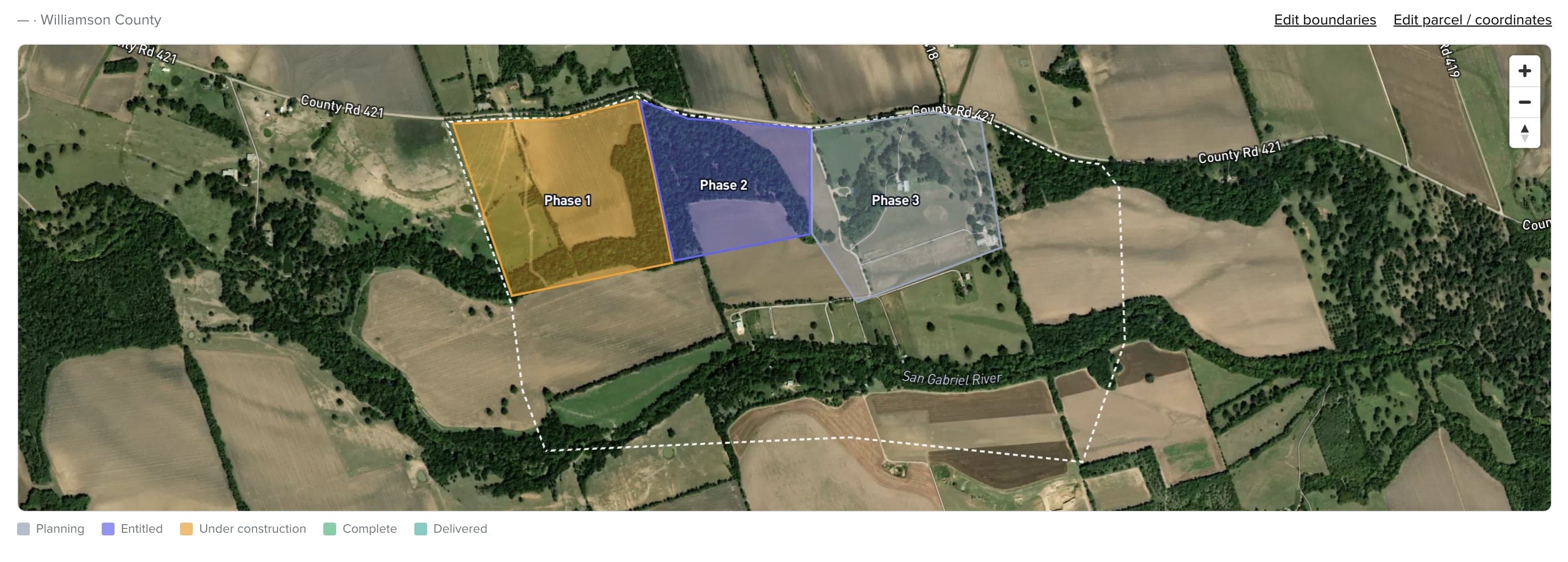
An interactive parcel map renders the boundary and each phase as a colored polygon by lifecycle status - delivered, under construction, planning, and more. Click any phase for its name, status, lot count, and acreage. It's the at-a-glance view of a community's journey from raw dirt to delivered lots.
Deliver & Go Vertical
Delivery isn't a handoff - it's a continuation. A delivered phase promotes into a real community and section right inside Pipsy, and the same platform keeps running the process as homes go vertical: lot contracts and takedowns with your builders, then home sales and closings to buyers. And because gap-out analysis watches absorption in real time, the timeline loops - Pipsy tells you when to start the next phase before you run out of lots.
Delivery → Vertical, In Place
When a phase delivers, it promotes into a real community and section and seeds actual lots - no export, no import. Pipsy keeps tracking them straight through vertical construction, home sales, and closings to buyers.
Lot Readiness Certificates
A lot is not finished because someone says so. Each one earns a readiness certificate against the checks you require - city acceptance, pad certification, dry utilities, a clear punch list, and an optional drone or drive-mode pass - with the evidence attached and certificates issued in bulk rather than one at a time. Phase acceptance, drone vision, and Drive Mode can suggest that a lot looks ready, but they never sign for it; a person does. Where you turn the gate on, a lot cannot be funded until its certificate is issued, so nobody takes down a lot that is not actually there.
Lot Contracts & Builder Finance
The contracts and money between developer and builders run in the very same system - lot purchase agreements, takedown schedules, earnest money, lot releases, and payments - so every lot a builder commits to is followed from signed contract to closing, with no separate financial system to reconcile.
Gap-Out Analysis
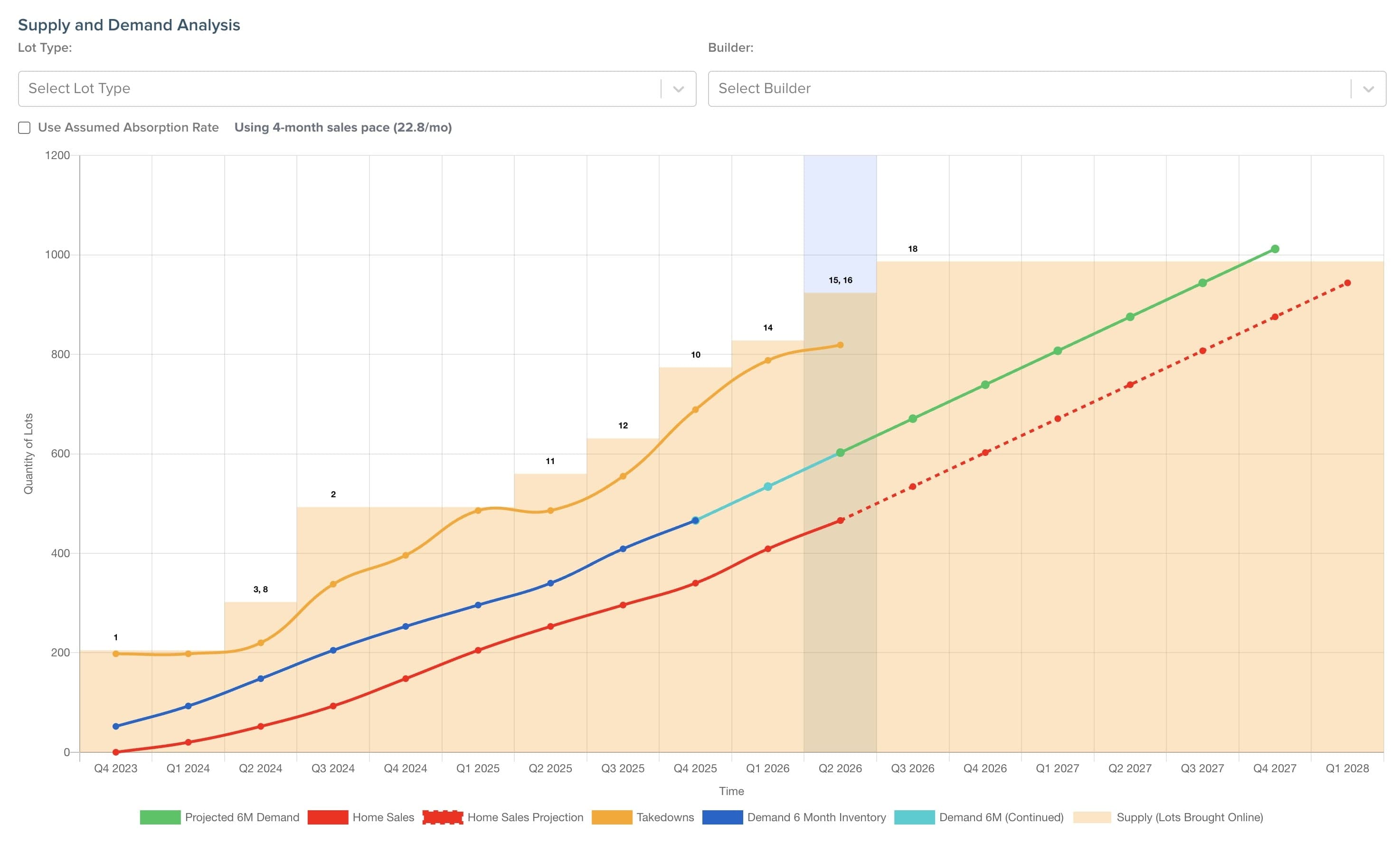
Pipsy watches absorption on the vertical side and forecasts when each builder, lot type, or section will run dry - constantly signaling the development team when to start the next phase or section before lots run out. Every row carries the date you have to pull by, how pace is running against underwriting, and the decision itself: open the next planning phase, release a phase to construction, or record a hold with your reasoning. The decision sticks to the project, and the same pull dates show up in the weekly AI briefing.
Closings That Start The Rest Of The Work
A home closing is the trigger for half a dozen things nobody should be retyping. Pipsy turns each one into an event and hands it to whichever downstream systems you switch on: HOA setup, the district's connection count, the welcome packet, your resident experience app, and a signed webhook into anything else you run. Every delivery records its own result, and you can retry a failed one, replay a closing, or backfill history without touching the closing itself.
Reporting & Exports
One-click project one-pager PDF - stage, budget health, next dates, RLV and IRR - plus Excel budget and draw exports for investors and partners.
When a phase delivers, it promotes into a real community and section and seeds actual lots - no export, no import. Pipsy keeps tracking them straight through vertical construction, home sales, and closings to buyers.
A lot is not finished because someone says so. Each one earns a readiness certificate against the checks you require - city acceptance, pad certification, dry utilities, a clear punch list, and an optional drone or drive-mode pass - with the evidence attached and certificates issued in bulk rather than one at a time. Phase acceptance, drone vision, and Drive Mode can suggest that a lot looks ready, but they never sign for it; a person does. Where you turn the gate on, a lot cannot be funded until its certificate is issued, so nobody takes down a lot that is not actually there.
The contracts and money between developer and builders run in the very same system - lot purchase agreements, takedown schedules, earnest money, lot releases, and payments - so every lot a builder commits to is followed from signed contract to closing, with no separate financial system to reconcile.
Pipsy watches absorption on the vertical side and forecasts when each builder, lot type, or section will run dry - constantly signaling the development team when to start the next phase or section before lots run out. Every row carries the date you have to pull by, how pace is running against underwriting, and the decision itself: open the next planning phase, release a phase to construction, or record a hold with your reasoning. The decision sticks to the project, and the same pull dates show up in the weekly AI briefing.
A home closing is the trigger for half a dozen things nobody should be retyping. Pipsy turns each one into an event and hands it to whichever downstream systems you switch on: HOA setup, the district's connection count, the welcome packet, your resident experience app, and a signed webhook into anything else you run. Every delivery records its own result, and you can retry a failed one, replay a closing, or backfill history without touching the closing itself.
One-click project one-pager PDF - stage, budget health, next dates, RLV and IRR - plus Excel budget and draw exports for investors and partners.
The land-development side and the home-sales side are the same platform.
Other platforms just start at "delivered." Pipsy was already there for everything that came first - sourcing the dirt, underwriting the deal, running entitlements and horizontal construction - so when a phase finally delivers, its lots are born inside the same system instead of imported into a new one. And it doesn't stop there: delivered phases promote into real communities and sections and seed the lots, then the same platform runs the contracts, takedowns, and payments between you and your builders straight through vertical construction, sales, and closings, while gap-out analysis signals when to start the next phase. No export, no import, no second system - one continuous loop, from raw dirt to closed homes.